
Slush Season
Non-native species and ecological attention

Spring, in Northeast Ohio, is not a thing. We go from winter to slush season, which is a combination of rain, snow, and sunshine that leaves the ground beneath our feet some kind of muck. The muck then merges with our waterways and starts the boom and bust cycle of our local Lake Erie tributaries. Slush lasts for most of March and April, and does its best to break in May. Unless you’re a birder catching the slush migration, there isn’t much to keep people around here during this time of year. Snowbirds assemble! Well, that’s not entirely true. There is one thing, and maybe even the best of things: steelhead.
We call them steelhead, anyway, but they might be more accurately referred to as lake run rainbow trout. No matter how you tie it, someone will take offense to the name. Regardless of what we call them, we all still love them. We all still love fishing for them. The thing about steelhead, at least those in Ohio, and for that matter, any rainbow trout east of the Mississippi, is that they ain’t from around here. Rainbow trout, and their steelhead siblings, are all native to the northern Pacific drainages from southern California all the way around to Russia.
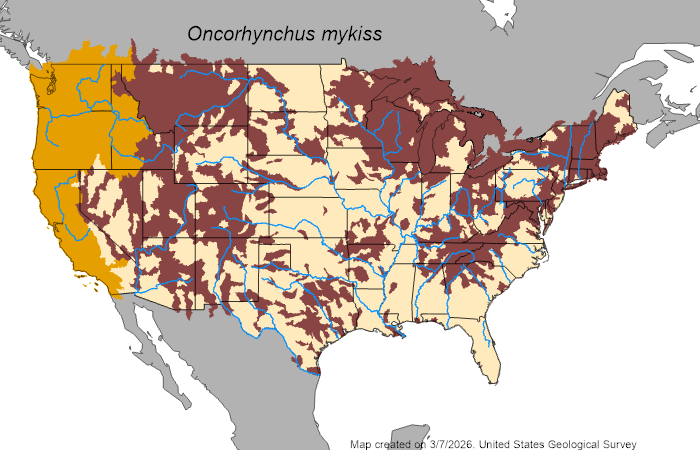
After a failed attempt in the late 1800’s, the first successful stocking of steelhead in Ohio came in 1975 as part of a larger effort to introduce a variety of anadromous species to Lake Erie. By 1996, the Ohio Department of Natural Resource (ODNR) had found the best strain of steelhead to survive in Lake Erie and its tributaries, with eggs taken from fish in the Little Manistee River in Michigan. About 2,000,000 steelhead smolt are released annually in Ohio, and many of them swim back up the rivers to spawn in the fall and spring. The lack of access to saltwater is one reason to refer to Ohio fish as lake run trout, but the other, more critical, is that they need stocking programs to keep their populations going. There are some places in the Great Lakes where these fish have naturalized, and there is even some reproduction in a few Lake Eries tributaries, but overall, the fish need the people. Perhaps more importantly, during slush season, the people need the fish.

There are economic components to the steelhead fishery, millions of dollars of components, and important ecological questions yet unanswered. What is the impact of steelhead on native brook trout and smallmouth bass? How do we best spend the proceeds from the steelhead fishery? All of these questions, including the initial question of whether or not to introduce steelhead to the ecosystem, revolve around our cultural views on non-native and invasive species.
Invasive Species are (1) non-native (or alien) to the ecosystem under consideration and (2) a species whose introduction causes or is likely to cause economic harm, environmental harm, or harm to human health.
Non-native Species are plants and animals living in areas where they don't naturally exist. Often they were intentionally introduced by humans, such as livestock or ornamental plants, but they could have been accidentally brought into new areas.
Steelhead, so far as we know, seem to stay in the non-native category. This is in contrast to something the residents of Ohio know well; the zebra mussel. There are other local examples like sea lampreys and the spotted lantern fly, and if we look further south in Florida, we can see kudzu, pythons, and lion fish. The key to the invasive moniker is that the populations cause certain economic, environmental, or human harm, apparently, in that order. To say something is invasive is to wish that it were gone or that it could be stopped, or in many cases, a resignation over its inevitability. Non-native species are different, they are a big gray area.
These two concepts, non-native and invasive, are ok for most discussions. We know what they mean. It’s not my intent to lump steelhead, brown trout, or carp into a category that determines their destiny. What I want to discuss is something broader, larger, something that extends beyond the levels of species. Instead of asking what one species is, what it does, and how it fits with an ecosystem, why not also ask what our relationship with that species might be?
There are terms that are similar to what I am describing. Stewardship is a favorite. Stewardship evokes a certain balance, and certain proper relationship between people and nature. I have also used the term Ecological Attention to describe how we can better place ourselves in the proper cosmic order. Ecological Attention is a deliberate practice to contemplate our relationship with nature, and we need to do this around our ideas of non-native and invasive species. Ecological attention expands our awareness around environmental issues to people, yes, but to the relational changes that occur due to a certain natural resources management decision. It’s this relationship we ought to cultivate before we try to propagate anything else.
The steelhead fishery in Ohio reminds me of my graduate studies in New Zealand, where I looked at the social and political management structures around Te Waihora/Lake Ellesmere. Like steelhead, that need our ecological assistance to survive, Te Waihora/Lake Ellesmere was opened to the sea each year to keep the water level low enough to allow residential homes, recreation, and agriculture. I don’t intend to comment on the opening of the lake being a good idea or bad in this piece, but I do want to highlight the idea that once the community decides to open the lake, and builds infrastructure on the land there, it has made a commitment, likely for generations, to continue to modify the landscape. Sounds a bit like steelhead in Northeast Ohio. The way things are going, we will have to stock fish forever if we are going to have the opportunity to fish for them here.
Another example of the complications of looking at species introduction simply through the lens of non-native and invasive species is the contrast of wild sheep and Rocky Mountain goats in the western United States. In some cases, conservationists build water guzzlers for wild sheep to survive on a landscape where they were struggling or extirpated. Are we to water the wild forever? On the other hand, mountain goats might have been introduced to habitat not far from their historical range, and though they exhibit the naturally accelerated growth curve of a non-native species, they often find a balance with the local flora and fauna. Despite these realities, there are those who value caring for sheep forever over allowing goats to live in a habitat just one state away from their historical records. If we think goats moved south after the glaciers receded, might they have made it to those foreign habitats anyway? Might the sheep have died out in a changing climate?
I don’t have all the answers to these questions, but these are questions we need to ask. We need to ask them because if we are going to enjoy steelhead, if we are going to farm the fields around Te Waihora/Lake Ellesmere, we need to know what it takes to keep the environment under our thumb. To what are we committing? Can we ever back out of it? What are the trade offs?
Maybe a better question to ask is, how does this species or management change impact the relationship between people and nature? The best path isn’t to do nothing, but neither is it to choose the path of most control. I love steelhead and lake run rainbow trout, but I know they wouldn’t be here if not for us. I would be ok if we instead put efforts into our smallmouth and freshwater drum resources that we know can last generations without any input from us. We should nurture and support our fisheries, yes, but control them? No.
There is one thing that sticks out to me about non-native species, about wild sheep watering holes, and introduced mountain goats. Each of these species brings me closer to nature, to the wild. I don’t know if they will always be there, or they should be, but I don’t even know that about me. What I do know, is that the answers to these questions won’t come from all this sitting around typing on a MacBook. It’s slush season, and no matter my thoughts on the philosophy of our local fishery, I will be out there swinging flies in the muck, rain and even a little sunshine. If you weren’t already aware, all questions are answered with a fish on the line.
Maybe it’s worth it to keep stocking all those steelhead, forever, after all. Only time on the water will tell.
AFIELD Notes can now be accessed with a traditional url! Please visit at www.readafieldnotes.com.
If you are interested in the topics reviewed in this article, you may like a fictional take I explored, here: Invasive Treatment.
Great read! Great fishery!