
Trail Riders On the Range
Digital fencing and the restoration of the West

I spent the morning on horseback on a ranch outside of Kremmling, Colorado. Given my height, the wranglers and our guide, Bailey, paired me with some kind of equine creature named Thor. After adjusting the stirrups, we proceeded to have a fine day together of occasionally picking our own trails but otherwise generally sniffing the butt of the horse in front of us. I love the idea of riding horses, but in practice, it’s hard to be any good at it or to form a connection with an animal when your riding is limited to a single morning on horseback every three years.
Along our route we had the pleasure of hearing the wind dance through the aspen leaves, earning a sweaty sunburn, and a few good views. For a moment, it was easy to imagine the old days of open range in the American West, where cowboys slept under the stars and pushed cattle across the lands to market and transport into the cities of the east coast. The myths of that time still permeate the American ethos as much as anything. And for good reason! Independence, grit, wilderness, and few gunshots is a romantic ideal. I remember reading Zane Grey’s Riders of the Purple Sage as a young man, then tasting the dry western air and splashing my face with cold creek water in a little mountain oasis when I first traveled west for elk hunting. Cold, clear water never felt so good, the dust never bothered me less.
The modern reality of the cowboy, at least most of them, doesn’t always impact me the same way. The open range had its own problem in the form of the Tragedy of the Commons and gave way to a little more than a few friendly gunshots and law enforcement. There is also the issue of cattle. Though I find myself much more sympathetic—and agreeable—to the views of ranchers than monocropping farmers, I can’t say I am thrilled when I see an elk colored cow traipsing through public land on my $1,500+ once a year elk hunt. I don’t mean to address the Public Land grazing issue here, but point it out only to highlight another reality of modernity. Most call it barbed wire, some call it fencing, and I call it Devil’s Braid. It cuts across the narratives of my heart like a garrote on my neck.
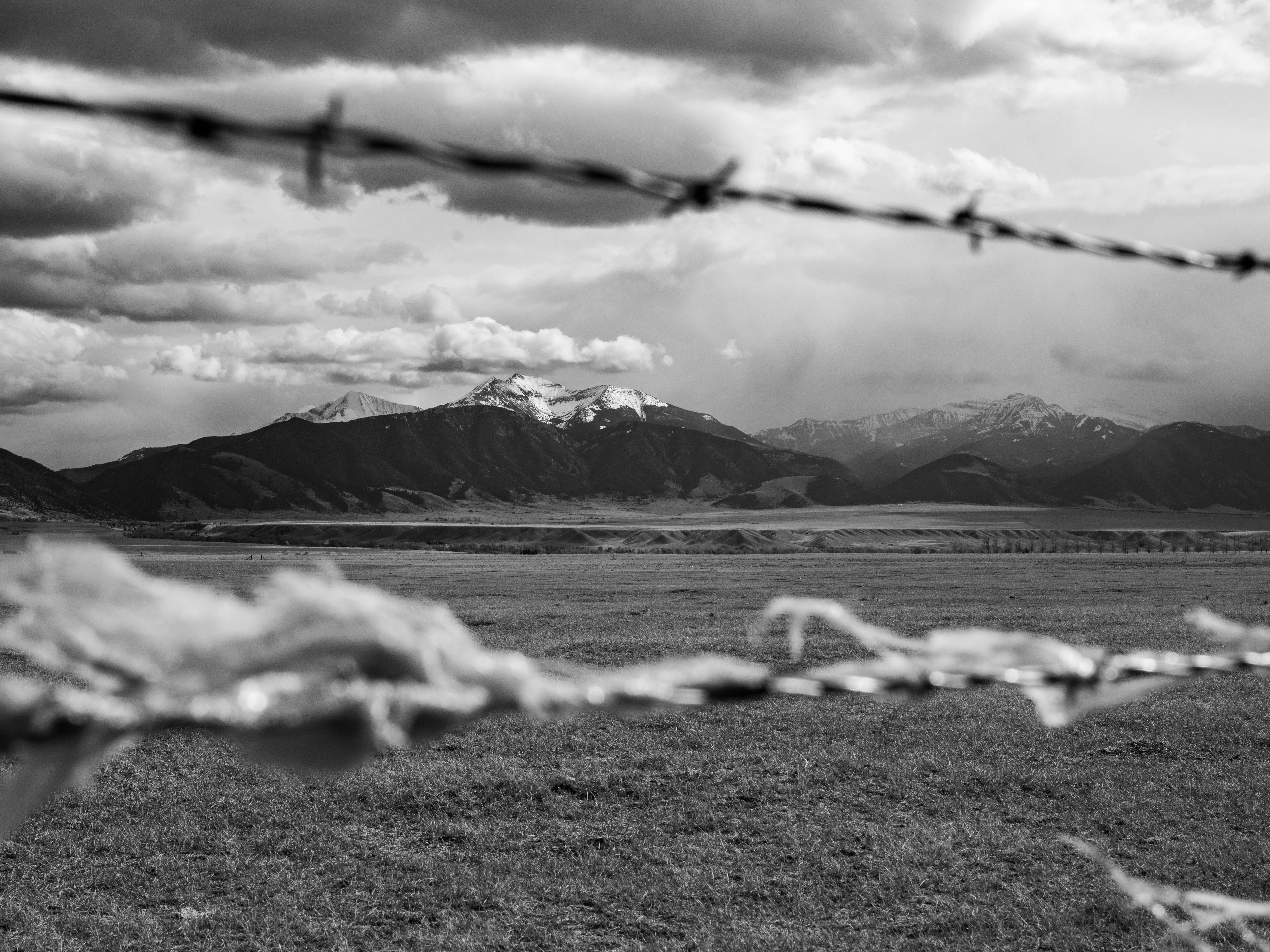
We saw some of the wire on our trail ride stretched across paddocks and along property lines. I see it on my other forays out west both on foot, and along miles and miles of wilderness landscape. Though I could not zoom in on the squared off property lines seen through the airplane window, it was easy to imagine the braided borders. The wire is everywhere. This is where my inner conflicts rises up, I love the idea of cowboys, but I absolutely despise barbed wire.
There are reasons to not like the wire. I won’t list them all here, but I will share my two primary issues. First, it just feels wrong. When I imagine the American West, in all its beauty, adventure, questionable history, and epic ethos, the barbed wire fence is a physical manifestation of the death of that myth. The second reason I detest the blood braid is that it breaks up the landscape in a way our imaginary property lines do not. This bothers me, yes, but it also impacts wildlife. We’ve all seen the deer with its back leg caught in the fence, our dogs have battle scars, but the biggest issue comes back to the cowboy mythos. The open range is not possible now, even if we somehow agreed to try it again. In other words, the very wire that epitomizes the West is the very thing that actually killed off the West.
Although Elinor Ostrom could help us get close to an open range common pool resource plan, I am not sure we could ever go back to it. That time is gone. But, there is something we can restore, something we can do right now. We can remove the barbed wire. All of it.
For the first time in the pages of AFIELD Notes I am bringing you a technological solution to a spiritual problem. And yes, the loss of one of our founding myths is a spiritual problem, whether we recognize this or not. A trail ride is great, but it is no echo of the wild west. Today, ranchers and leaders at the Property and Environment Research Center (PERC) are creating ways to leave the barbed wire behind, to take the fencing digital.
Kat Dwyer, Marketing and Media Manager at PERC, describes the issue like this:
Across the American West, fences are both essential infrastructure and a growing conservation challenge. Hundreds of thousands of miles of wire fencing help ranchers manage livestock, but they can also fragment habitat, disrupt wildlife migration, and require constant maintenance. As wildlife pressures, development, and management costs rise, producers and conservationists alike are searching for better tools. PERC’s new roadmap highlights how virtual fencing, which uses GPS collars to manage livestock via sound and mild stimulus, offers a way to remove these physical hazards without compromising ranching operations.
Her article continues to summarize the benefits of virtual fencing:
Virtual fencing restores critical connectivity by substituting for physical interior fences, which allows migratory species like mule deer, elk, and pronghorn to move freely across the landscape.
Precision habitat management becomes possible as ranchers use digital boundaries to “precision exclude” livestock from sensitive riparian zones, sage grouse leks, or recently burned areas via a smartphone or laptop.
Virtual fencing technology reduces wildlife conflict by allowing ranchers to move cattle away from known carnivore dens or real-time predator locations, effectively minimizing the “dinner bell” effect that leads to depredation.
Future software could streamline “conservation mode” by including default settings for riparian buffers, making it easier for conservation groups to verify and reward sustainable grazing practices.
I don’t often suggest technological solutions because in my experience, they act more as a way to sever us from the land, to negatively impact us and the landscapes we inhabit. Making things easier isn’t always the answer, and plugging in to check out rarely creates a healthy pathway to connections with the earth. But, in this case, wireless fencing, when it results in the uprooting of ancient barbed wire demons, acts to restore ancient connections that have been severed. There was a brief time, a wild time, when cowboys roamed the land. There was a time before then, maybe even a time immemorial, when Native Americans roamed the wide open places of our continent, too. There are deeper threads to unravel in both of those histories, and their conflicts, but neither of them included barbed wire, neither of them included a physical severance of Devil’s Braid across the landscape.
The open range is gone. Time has changed our landscape too much to go back. But new wireless fencing technologies can allow us to keep the mythos of the west alive, to allow wild animals their rightful migration routes, for cowboys to ride their land without being reminded of lawyers and surveyors in the big cities, and for us visitors on trail rides to see a wide open space unmarred by metal barriers better fit for trench warfare.
In some ways I liken this wireless fencing technology to the earth’s magnetic fields that species use to navigate the planet. Not all of us are in tune enough to use dead reckoning to navigate, but we can follow digital paths that we know are healthy, maintained, and properly cared for. Over time, those routes and boundaries we can only see on screens will become second nature, they will become our magnetic fields. Maybe in the routes of the future there is something like open range, there is something like sleeping under the stars.
My trail ride only lasted a few hours, but the West can last forever. PERC, ranchers, and other cowboys can help. So too, for once, can technology.
To read the full report on digital fencing from PERC, please click here.